
Beverage Packaging Has Entered a New Accountability Era
California and the EU are changing packaging requirements on different schedules. Here is what the rules measure, and what a bottle’s label can actually establish.
Editorial · not medical advice
A bottle can contain recycled plastic, be accepted by a local recycling program, and still end up in the trash. Those are three separate facts about its life.
Packaging rules increasingly measure more than one of them. California’s producer-responsibility regulations took effect on May 1, 2026. The EU’s Packaging and Packaging Waste Regulation began applying on August 12. A separate California law already sets recycled-content requirements for covered plastic beverage containers.
For a beverage buyer, the first step is to identify which claim is being made. “Recyclable” describes a package’s eligibility within a system. “Made with recycled content” describes its material inputs. Neither tells you what happened to the bottle after someone finished it.
Three regulatory tracks
These frameworks cover different materials and obligations. Product coverage, exemptions and implementation provisions determine what a particular business must do.
California SB 54: producer responsibility
California’s SB 54 implementing rules took effect on May 1, 2026. Producers fund and plan for the management of covered materials. The 2032 statewide targets include a 25% reduction in covered single-use plastic, 100% recyclable or compostable covered packaging and plastic food-service ware, and a 65% recycling rate for covered plastic. These are future program targets, not statements that every package already meets them.
There is an important distinction for beverage buyers: containers subject to California’s bottle-deposit law are excluded from SB 54’s definition of covered material. Other packaging used to group or transport beverages may still fall within scope. The bottle and the packaging around it need to be considered separately.
California AB 793: recycled plastic in beverage containers
AB 793 addresses postconsumer recycled plastic in beverage containers subject to California Redemption Value, or CRV. The general minimum rose to 25% in 2025 and is scheduled to reach 50% in 2030, subject to applicable exemptions and adjustment provisions.
Reporting concerns the pounds and resin types of virgin and postconsumer recycled plastic used in covered beverage containers. CalRecycle publishes manufacturer reports. The annual-average requirement should not automatically be read as the composition of each individual bottle. Exemptions also matter: some manufacturers remain subject to reporting even when exempt from minimum-content requirements or penalties.
The EU: phased packaging requirements
The EU’s Packaging and Packaging Waste Regulation covers packaging composition, waste prevention, recyclability and other requirements across the EU market. General application began August 12, 2026; individual obligations have phased dates.
The European Commission’s implementation announcement highlights limits on PFAS in food-contact packaging from August 2026. It describes later phases for sorting labels, recycled content and other measures. The regulation itself governs the exact deadlines and conditions; not every requirement began on the general application date.
A packaging PFAS restriction concerns the packaging material. It does not establish the PFAS status of the beverage inside.
Four claims, four kinds of evidence
When comparing packages, look for documentation that matches the claim.
- Recyclability: the material and format, plus the collection and processing system available in the relevant market.
- Recycled content: the percentage, material type and accounting basis. Postconsumer material has already completed a consumer use.
- Recycling rate: measured collection and processing outcomes under a stated method.
- Reuse or refill: an operating system for return, cleaning, inspection and repeated use.
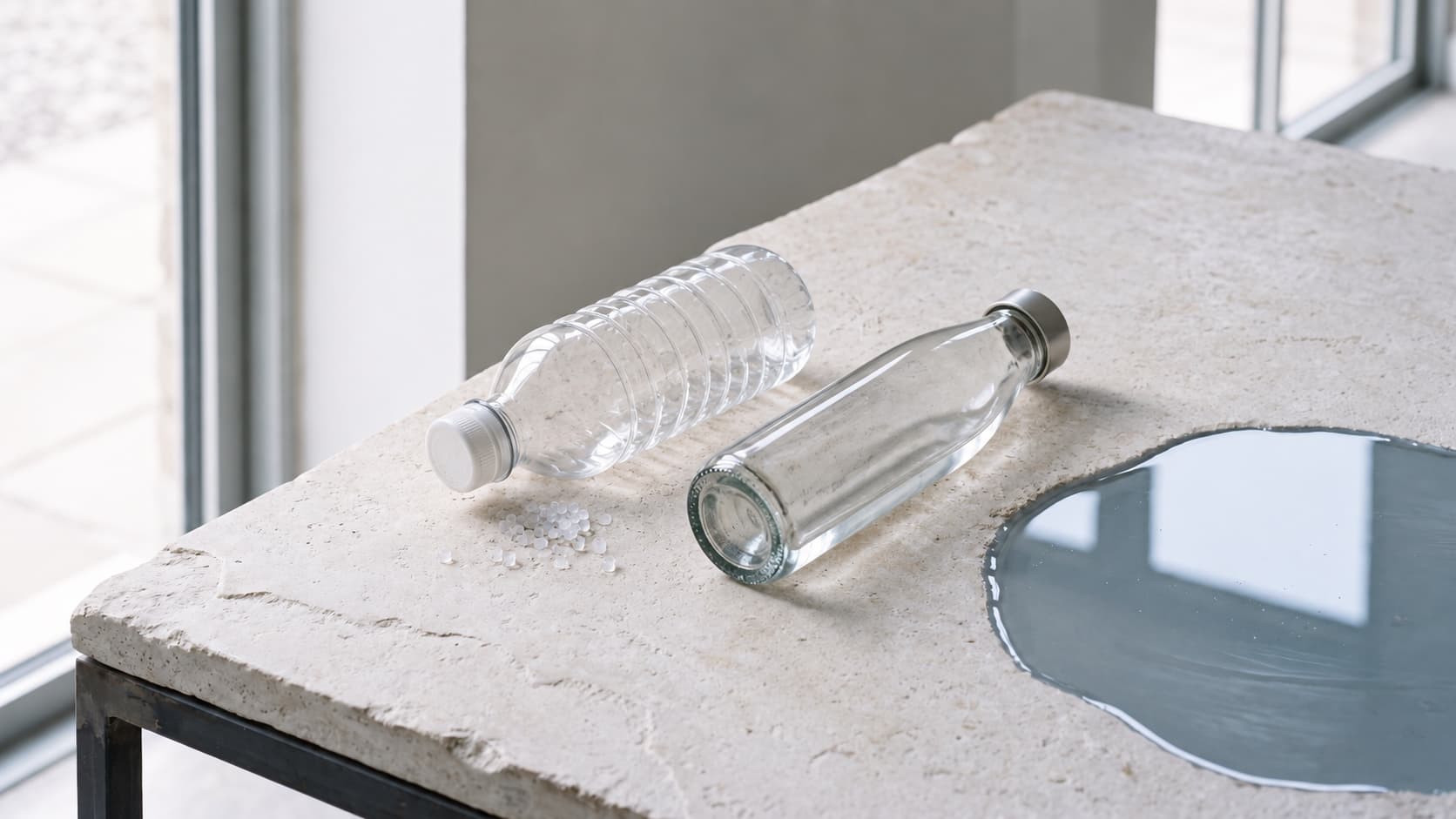
A container’s appearance cannot supply those details. Clear glass does not reveal its recycled share. A resin symbol does not tell you whether a local collector accepts that format.
Comparing glass and PET
Weight, shipping distance, breakage, recycled inputs and the number of reuse trips can all affect a package’s environmental footprint. A comparison needs a defined product, route and end-of-life scenario. Choosing a material by itself leaves much of the calculation unfinished.
Recovery uses BPA-free, recyclable PET; Reserve is a limited glass release. Those describe Unbelievable’s formats. They do not establish a recycled-content percentage, collection rate or comparative emissions result.
For any bottle, check the disposal instructions where you actually use it. For a broader environmental claim, look for the supporting calculation or report, including its date and boundaries. A brand selling into several markets may need different instructions and evidence for each.
Sources
- European Commission: New EU packaging rules start to apply, August 11, 2026
- EUR-Lex: Regulation (EU) 2025/40 on packaging and packaging waste
- CalRecycle: California packaging producer-responsibility rules take effect, May 1, 2026
- CalRecycle: SB 54 Plastic Pollution Prevention and Packaging Producer Responsibility Act
- California Public Resources Code section 42041: covered-material definitions and exclusions
- CalRecycle: Plastic minimum-content standards and reporting for beverage manufacturers
- California Public Resources Code section 14547: recycled-content requirements
Sources checked September 11, 2026.
More from the Journal

Water Science
WHO’s 2026 Drinking-Water Update Looks Beyond the Final Test
WHO’s June 2026 update gives small water supplies more attention and strengthens practical guidance on preventing contamination.

Water Quality
EPA Estimates Four Million Lead and Galvanized Service Lines Need Replacing
EPA’s 2026 funding allocation uses an estimate of roughly four million lead and galvanized service lines requiring replacement. Here is what that number means—and how to ask about the connection serving your home.