
Why the Water Changes Your Coffee and Tea
Water is the largest ingredient in a brewed cup. Its mineral composition and buffering capacity can change the drink, but more extraction does not necessarily mean better flavor.
Editorial · not medical advice
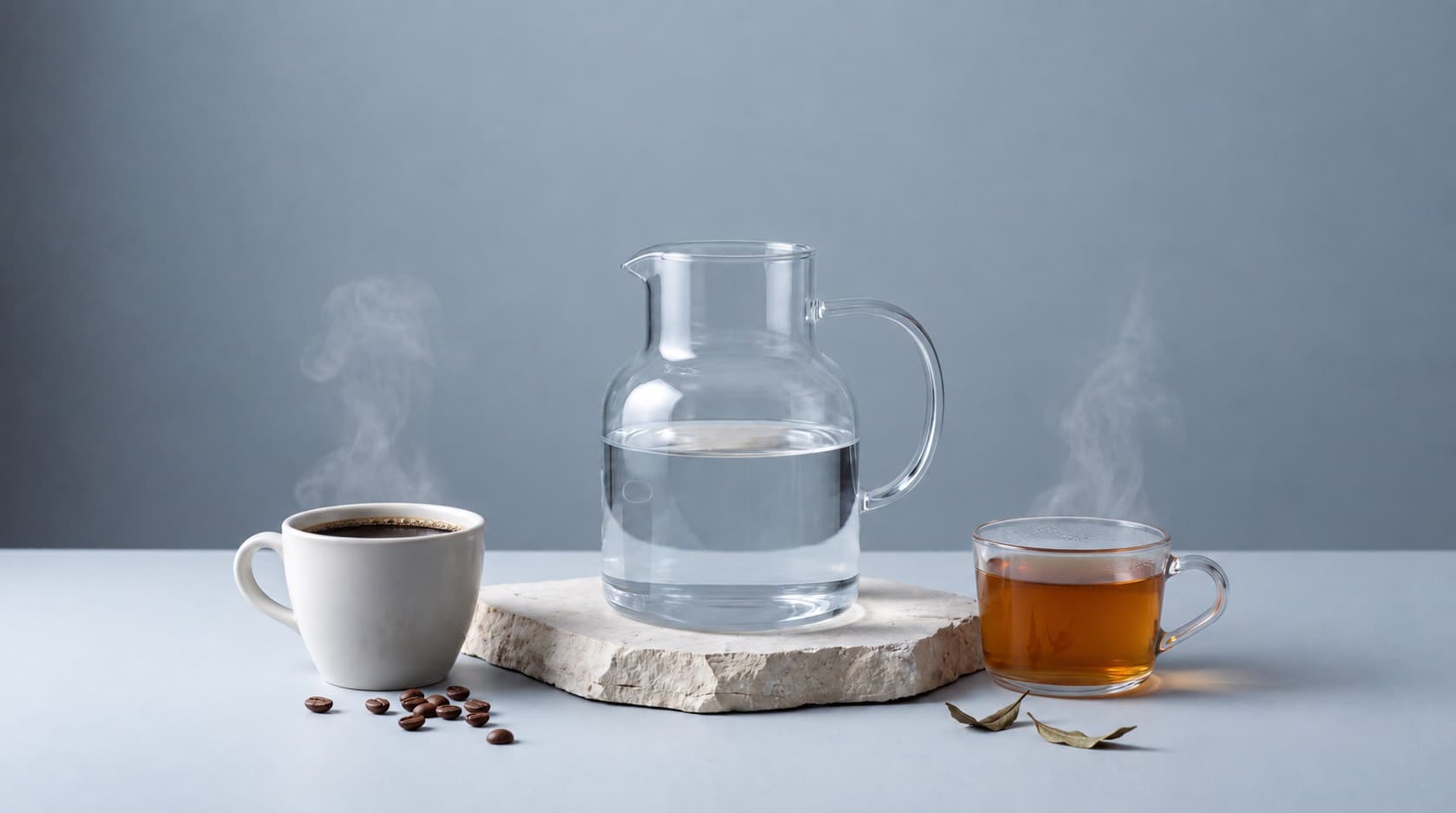
Use the same coffee, grinder and recipe in two cities and the cups may not match. Brew the same green tea with two waters and its color, bitterness and clarity can shift. Before changing the beans or leaves, try changing only the water.
During brewing, hot water dissolves compounds from the coffee grounds or tea leaves. What is already dissolved in that water can influence the finished drink. Some effects involve extraction; others involve reactions in the cup. The distinction matters when someone promises that one mineral will unlock better flavor.
Two properties do different jobs
Hardness mainly reflects dissolved calcium and magnesium. Alkalinity describes how much acid the water can neutralize, often through bicarbonate. They are related parts of water chemistry, not interchangeable measurements.
Alkalinity helps explain why a coffee's acidity can seem softer with one water than another. More buffering can reduce the bright impression you wanted from the coffee. Less buffering leaves more of its acidity unneutralized; whether that tastes pleasing depends on the cup.
In its discussion of water and coffee acidity, the Specialty Coffee Association explains why alkalinity can matter more than starting pH when brewing water is near neutral and has appreciable buffering capacity. It also notes that beverage ratio changes how much buffering water meets a given amount of coffee.
A TDS number cannot tell you that balance. Our guide to TDS, hardness, alkalinity and pH separates the four measurements and their units.
Coffee chemistry is more complicated than “more minerals”
A 2014 computational study modeled how dissolved ions bind to selected coffee compounds. It offered a possible explanation for mineral-dependent extraction, but did not directly brew coffee or measure people's preferences.
A 2024 brewing experiment tested calcium and magnesium salts added before or after brewing. For the four organic acids measured, the lower salt concentrations produced limited changes, and pre-brew versus post-brew results were usually similar. That points toward interactions after extraction, rather than a simple rule that calcium or magnesium pulls more acid from the grounds.
This was one dark-roasted blend and a controlled immersion preparation. The experiment did not include bicarbonate or settle the behavior of every coffee compound. Neither paper establishes a universally best brewing water.
Equipment adds another constraint. Heating hard water can produce calcium-carbonate deposits. A pleasing pour-over result does not establish that the same water is suitable for an espresso boiler. Follow the machine maker's water specifications and maintenance instructions; taste alone cannot assess scaling or corrosion risk.
Tea makes the effect visible
In a 2019 Cornell study, researchers compared green and black teas made with bottled, tap and deionized waters, keeping preparation conditions consistent within each tea type. Water changed color and cloudiness, and the flavor effects were more pronounced for green tea.
The bottled and deionized waters had much less calcium and magnesium than the tested tap water. Their green-tea infusions contained about twice as much EGCG, a tea catechin, and were rated more bitter by the 103-person panel. The tap-water green tea was perceived as sweeter and received higher overall liking than the bottled-water version; its liking advantage over deionized water was not statistically significant in the pairwise comparison.
Those results belong to the particular teas, waters and panel tested. They do not rank all tap water above bottled water, and measuring more EGCG does not demonstrate a health benefit. A chemical measurement and a preference score answer different questions.
Run a controlled kitchen test
Start with manual brewing: a pour-over, a simple immersion coffee preparation or tea in matching heat-safe vessels. Choose two waters already suitable for drinking, with different published compositions. Use water intended for consumption, not laboratory-grade deionized water. Check the kettle maker's guidance too.
There is no need to start mixing mineral salts. For a useful first comparison:
- Use the same coffee dose and grind, or the same tea and leaf weight.
- Weigh equal amounts of water. Match temperature, contact time and brewing technique.
- Use identical serving cups and compare at the same comfortable drinking temperature.
- Ask someone else to code the cups and keep the water identities hidden until you have written your notes. If you prepared everything yourself, treat the result as an informed comparison, not a fully blind test.
- Repeat the comparison, reversing the tasting order, before changing the recipe.
For coffee, note acidity, sweetness, bitterness, body and finish. For tea, add color, clarity, aroma and astringency—the drying sensation in the mouth. Record which you prefer separately from what you notice. “No clear difference” is a useful result too.
After tasting, look at calcium, magnesium and any published alkalinity or bicarbonate result. Check the units: bicarbonate in mg/L is not numerically interchangeable with alkalinity reported as calcium carbonate. If a number is missing, leave it unknown rather than inferring it from pH or TDS.
If Recovery is one of your samples, refer to its published mineral profile, remembering that typical values vary by batch. The profile does not currently provide an alkalinity result. This comparison is not a recommendation to use Recovery in every brewer, and it does not imply Specialty Coffee Association endorsement.
Keep the notes from both brews. Next time, change only one variable so you can tell whether a difference followed the water, the recipe or the brewing conditions.
Sources checked September 25, 2026.
Sources
- Hendon and colleagues — The role of dissolved cations in coffee extraction (2014).
- Bratthäll and colleagues — Influence of divalent cations on the extraction of organic acids in coffee (2024). The authors reported no specific grant funding and no competing financial interests.
- Specialty Coffee Association — Water and coffee acidity.
- Franks and colleagues — Water composition, flavor and extraction in green and black tea (2019). The authors reported no external funding or competing interests.
- U.S. Geological Survey — Hardness of water.
- U.S. Geological Survey — Alkalinity and water.
More from the Journal
Taste
How to Taste Water Like a Sommelier at Home
Set up a blind tasting with three or four waters, identical glasses and a scorecard. Compare what you notice before revealing the labels.
Water Science
Alkaline Water, Without the Hype
The evidence for alkaline water depends on the outcome studied and the water’s composition. A pH number alone cannot establish a health benefit.