
Can Minerals From Water Count Toward Your Diet?
Calcium and magnesium in water can contribute to dietary intake. Here is how to calculate the amount and interpret the absorption research.
Editorial · not medical advice
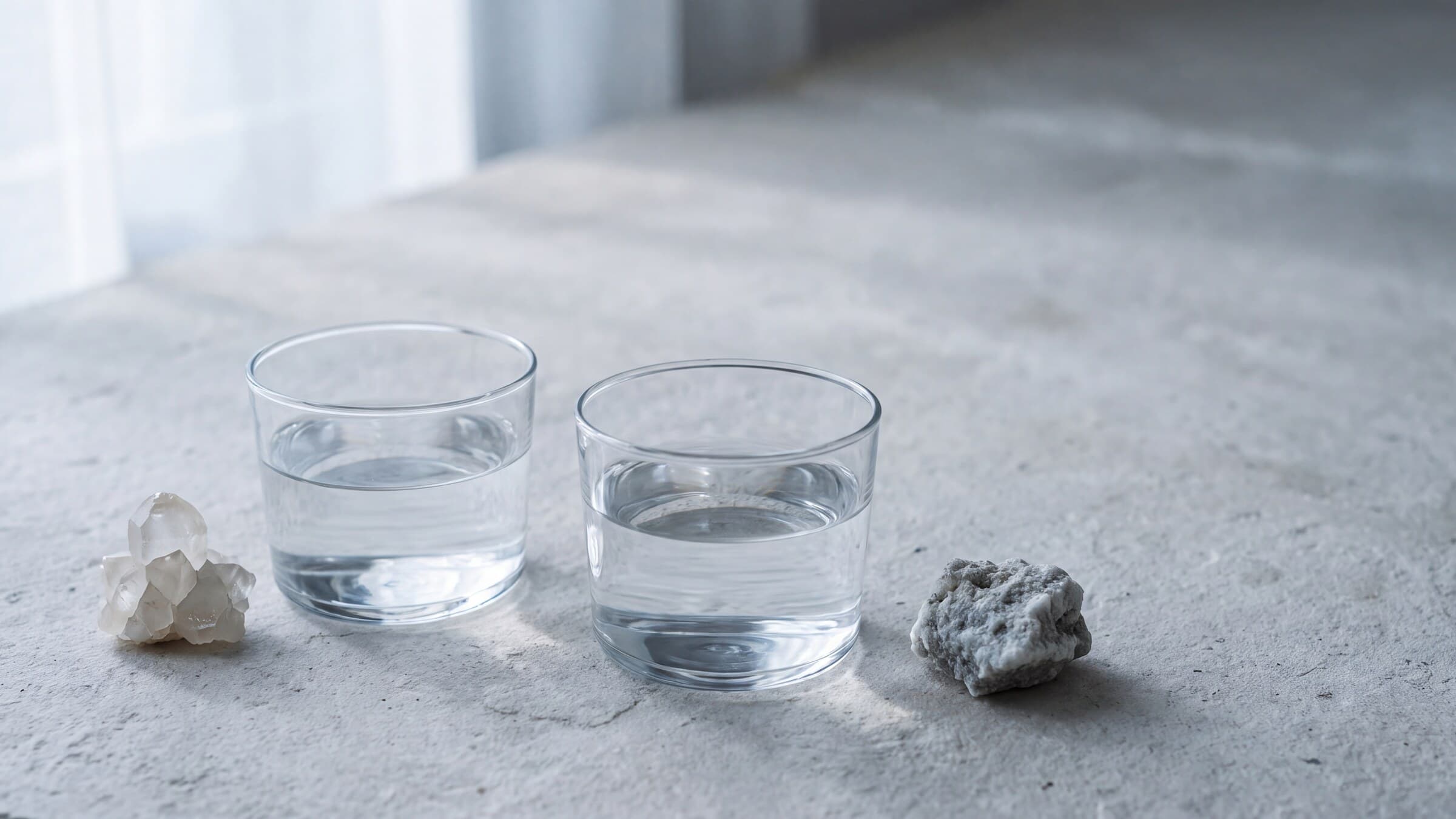
Half a liter of water containing 40 mg/L of magnesium supplies 20 milligrams. The same serving of a water containing 4 mg/L supplies 2 milligrams.
Both waters contain magnesium. The tenfold difference in dose is why the concentration matters when deciding how much a water contributes to your diet.
Calculate what you consume
Use the individual mineral result from the water analysis:
milligrams per liter × liters consumed = milligrams consumed
Unbelievable’s published Recovery profile lists approximately 61 mg/L magnesium and 20 mg/L calcium. The manufacturer’s August 5, 2025 production inspection recorded 60.85–60.90 mg/L magnesium and 19.88–20.12 mg/L calcium. Those results support the rounded figures for that tested batch; they are not a guarantee of the exact amount in every bottle.
At the rounded concentrations, a 500 mL serving would provide about 30.5 milligrams of magnesium and 10 milligrams of calcium. One liter would provide twice those amounts.
For context, the FDA’s labeling Daily Values are 420 milligrams for magnesium and 1,300 milligrams for calcium. The 500 mL calculation is roughly 7% of the magnesium Daily Value and less than 1% of the calcium Daily Value. These are arithmetic comparisons, not a reproduction of the bottle’s rounded Nutrition Facts panel.
Daily Values are general labeling references, not individualized targets. The example is not a recommendation to drink a particular volume. Check the current bottle label and batch documentation when making a product comparison; mineral concentrations can vary.
Can the body absorb those minerals?
Calcium and magnesium occur in water as dissolved ions. Bioavailability describes how much of an ingested substance becomes available for the body to use. It is separate from the amount consumed.
Two small randomized crossover trials help address the absorption question. The calcium trial studied 21 healthy adults using matched 300 mg calcium doses. The magnesium trial studied 22 healthy adults using matched 100 mg magnesium doses. The tested waters were compared with milk and a supplement for calcium, and bread and a supplement for magnesium.
The trials found no statistically significant differences in the short-term blood and urine measures used to assess bioavailability. Both were funded by the Association of German Mineral Water Bottlers.
The results support bioavailability for the tested waters and doses. They do not establish identical absorption from every water, prove a clinical benefit or show that a modest mineral concentration treats deficiency. A finding of no significant difference in these small trials should not be described as proof that all sources are equivalent. Neither trial tested Unbelievable Recovery.
How water fits with food
Food remains the main source of these minerals for most people. Legumes, nuts, seeds, whole grains and leafy vegetables provide magnesium. Calcium sources include dairy foods, fish with edible bones, certain vegetables and fortified foods. The NIH magnesium and calcium fact sheets describe dietary sources and intake considerations.
Water can add to that intake. WHO’s review of calcium and magnesium in drinking water examines their contribution to dietary intake. A water you drink regularly may provide a noticeable amount of one mineral and very little of another, as the Recovery calculation illustrates.
There is no reason to infer a deficiency from a water label, or to replace dietary or clinical advice with a mineral-water purchase. If you have prescribed fluid or mineral limits, follow that plan rather than using a general Daily Value as your goal.
Reading another brand’s analysis
Find calcium or magnesium separately; a TDS number combines dissolved substances and cannot supply either individual amount. Confirm that the concentration is in mg/L, then adjust for the volume consumed.
Also check what kind of figure is being reported. A typical production value, a result from one batch and a guaranteed specification have different meanings. Look for the underlying laboratory documentation where available.
Once those details are clear, the comparison is manageable: the mineral, its measured concentration and the amount in your serving. Keep absorption findings beside the waters and doses actually studied.
Sources checked September 20, 2026.
Sources
- World Health Organization — Calcium and magnesium in drinking-water: Public health significance
- NIH Office of Dietary Supplements — Magnesium fact sheet for health professionals
- NIH Office of Dietary Supplements — Calcium fact sheet for health professionals
- Journal of the American College of Nutrition — Calcium bioavailability trial, via PubMed
- Food & Nutrition Research — Magnesium bioavailability trial, full text hosted by Leibniz University Hannover
- U.S. Food and Drug Administration — Daily Values on Nutrition and Supplement Facts labels
- Unbelievable Water — Published Recovery profile and testing documentation
More from the Journal

Travel
Does Flying Really Dehydrate You?
Dry cabin air can make eyes, lips and skin uncomfortable. That discomfort alone does not tell you that the whole body is dehydrated.

Hydration
Yes, You Can Drink Too Much Water
A bottle can be a useful reminder to drink. Its capacity is not a prescription, and finishing more water is not automatically healthier.